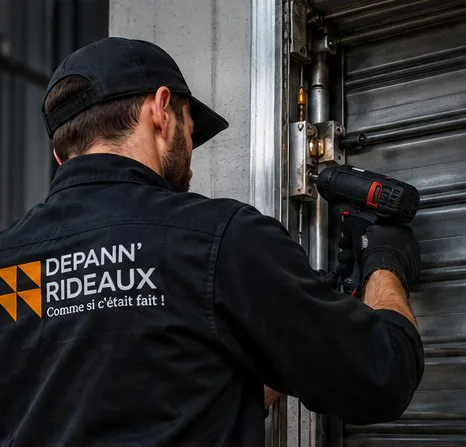
In short: a window roller shutter protects a window, French window or patio door in a home or office. It blacks out the room, insulates, keeps the heat out in summer and slows down a break-in. You choose one on three criteria: operation (strap, crank, wired motor, radio or solar), installation (external box for retrofit or box built into the wall) and slat material (PVC or aluminium).
Window roller shutter or shop roller shutter: what is the difference?
A window roller shutter fits the windows and patio doors of a home or office, while a metal roller shutter closes off a shopfront. Both roll up onto an axle and run down guide rails, but they are not sized or designed for the same job. The window shutter is about comfort: a dark bedroom, a cool house in summer, quiet and privacy. The shop shutter is first about resisting impacts and break-ins on a large opening.
| Criterion | Window roller shutter | Shop roller shutter |
|---|---|---|
| Where? | Windows, French windows, patio doors | Shop windows, shopfronts, delivery entrances |
| Slats | PVC or aluminium, often foam-filled for insulation | Galvanised steel or aluminium, solid, perforated or grille |
| Curtain weight | Light | Heavy, counterbalanced by springs or driven by a powerful motor |
| Operation | Strap, crank, tube motor, solar | Manual with springs, central or tube motor |
| Main purpose | Blackout, insulation, privacy | Protecting the shop and its stock |
Looking for a shop closure? See our section on shop roller shutters and grilles instead.
What are the parts of a window roller shutter?
A window roller shutter has six parts, whatever its operation. Knowing them helps you describe a fault on the phone and understand a quote.
The curtain
The interlocking PVC or aluminium slats. It is the part you see when the shutter is down.
Watch for: a broken slat, a slat out of its joint, light showing between two slats.The bottom slat
The stiffer bottom slat, often aluminium. It carries the seal that meets the window sill.
Watch for: a shutter that no longer closes flat, a bent bottom slat.The axle
The tube the curtain rolls onto, linked to the slats by straps or clips. On an electric shutter the motor sits inside it.
Watch for: a shutter that runs crooked, rubbing noises in the box.The guide rails
The two vertical rails that guide the curtain on each side of the window, fitted with seals or brushes.
Watch for: a shutter that always sticks at the same height, whistling in strong wind.The shutter box
The housing for the axle and the rolled-up curtain: mounted outside, inside or set into the masonry, depending on the installation.
Watch for: a draught above the window, an access panel that no longer closes properly.The operating system
Strap and winder, crank and gearbox, or a tube motor controlled by a switch, a remote or a solar panel.
Watch for: a frayed strap, a crank turning freely, a motor that no longer responds.What types of window roller shutters are there?
Window roller shutters are classified in two ways: by operation (manual, electric, solar) and by installation (retrofit or built-in). Every shutter combines both: a retrofit shutter can be manual, electric or solar.
By operation
- Manual roller shutter: with a strap for small windows, with a crank for larger ones. No electrical connection and very few faults.
- Electric roller shutter: a tube motor inside the axle, controlled by a wired switch or a radio remote, with the option of central control for the whole house.
- Solar roller shutter: also motorised, but powered by a small solar panel and a battery. No cable to run back to the fuse board.
By installation
- Retrofit roller shutter: the box is fixed in front of the existing window, on the façade or under the lintel. The solution for existing houses, without major building work.
- Built-in roller shutter: the box is set into the masonry above the opening and cannot be seen from outside. It is planned at the building stage or during a major renovation.
There are also boxes fitted on the inside, directly onto the window frame. During the survey, the technician checks what your façade and windows allow before suggesting a solution.
PVC or aluminium slats: which suit your window roller shutters?
PVC suits standard-sized windows and tighter budgets; aluminium is the choice for large patio doors, exposed façades and the seaside. Both come in several colours.
| Criterion | PVC slats | Aluminium slats |
|---|---|---|
| Stiffness | Adequate on windows of standard width | Stiffer, suited to wide openings |
| Insulation | Hollow slats (air chambers) | Double-walled, usually foam-filled |
| Sun and heat | Dark colours can warp in full sun | Holds up well, even in dark colours |
| Resistance to impacts and break-ins | More limited | Better, especially with anti-lift locks |
| Seaside | Does not rust, but ages in the sun | Choose a coated finish suited to salt air |
Maximum sizes and available colours depend on our suppliers’ ranges: they are set out in the quote after measuring up.
Which roller shutter suits a house in Normandy?
In Normandy, the climate points towards aluminium slats, well-fitted guide rails and a locked curtain, especially near the coast. Three local factors matter more than elsewhere.
For an old stone or half-timbered house with windows of varying sizes, made-to-measure shutters and retrofit installation are often the only realistic options. For a new build, a built-in shutter keeps the façade clean. Either way, the choice of operation depends on how you use the room: a spare bedroom can keep a strap, while a living-room patio door used every day is better electric.
What services do we offer for window roller shutters?
DEPANN'Rideaux covers the whole life of a window roller shutter, from advice to repair. You keep the same contact: the person who answers is a technician who knows your installation. We work for homeowners and businesses alike, on all brands: advice, shutters made to measure to the dimensions taken by the technician, fitting, motorisation, servicing and repair.
- Made-to-measure shuttersA shutter built to the exact size of your window, even a non-standard one.
- InstallationMeasuring, fitting, adjustment and a walk-through with you.
- MotorisationMaking a manual shutter electric without changing the curtain.
- ServicingCleaning, checks and adjustments to prevent breakdowns.
- RepairStrap, crank, slat, motor or remote: we repair the faulty part.
For a sound manual shutter that is hard work to operate, motorisation usually costs less than a new shutter. For an older shutter whose box, axle and rails are in good condition, a repair is often enough. We tell you straight, without pushing a replacement.
How does a roller shutter project with us work?
A fitting or replacement project follows five steps, and nothing is ordered without your written approval.
- 1First callYou describe the windows concerned, how you use them and what bothers you today. The technician points you to the right type of shutter.
- 2Site surveyEach opening is measured, and the lintel, façade and power supply are checked. The survey is free.
- 3Detailed quoteInstallation type, slats, colour, operation and options are set out window by window.
- 4FittingBox and guide rails fixed, motor connected if there is one, limit switches set.
- 5Testing and handoverSeveral up-and-down cycles, remotes programmed, servicing advice.
Manufacturing and fitting times depend on the number of windows and the model chosen: they are set out in the quote. Fitting is explained in detail on the roller shutter installation page.
How much does a window roller shutter cost?
The price of a window roller shutter depends on the window size, installation type, slat material, operation and options: it is set in a quote after a free site survey. A PVC strap shutter for a small window and an electric aluminium shutter for a large patio door are not comparable. What changes the quote:
- The size of the opening: width, height and therefore curtain area.
- The installation: retrofit box on the façade or box built into the masonry.
- The slats: PVC or aluminium, standard or special colour.
- The operation: strap, crank, wired, radio or solar motor, and any central control.
- The number of windows done at the same time and access (upper floor, scaffolding).
Repairs work differently: on the phone, you describe the fault and the technician tells you when he can come; the price is given to you on site, after the diagnosis and before any work starts. If you turn down the work after the diagnosis, only the call-out is charged.
Your window shutter is stuck: what to do before calling?
Start with the safe checks, then stop there if the shutter will not move: forcing it almost always damages another part. Circuit breaker, remote battery, a rest for the motor, clear guide rails: the full list of checks and common faults is on the window roller shutter repair page. In frosty weather, do not insist and wait for the thaw.
Stuck shop shutters are covered by our 24/7 emergency roller shutter repair.
How do you make a roller shutter last?
A window shutter lasts longer with clean guide rails, gentle operation and an occasional check. Rinse the rails with clean water, especially near the sea, avoid greasy products that trap dust, do not leave the shutter half-open in strong wind, and guide the strap rather than letting it go. A roller shutter servicing visit adjusts the limit switches and spots a worn clip or strap before it breaks. The general principles are close to those in our guide to looking after your roller shutter.
Where do we work on window roller shutters in Normandy?
We cover all five Normandy départements: Seine-Maritime, Calvados, Eure, Manche and Orne, from our base in Gruchet-le-Valasse, in the Pays de Caux.
The full list of towns we serve is on the areas we cover page.
Which page covers your window roller shutter?
Each page covers one type of shutter or one service: pros, limits, process and frequently asked questions.
- Manual shuttersWith a strap or a crank, the shutter with no motor or cable: simple, sturdy, easy to repair and can be motorised later.
- Electric shuttersTube motor, wired or radio control, central control and smart home: the shutter that opens at a touch or on a timer.
- Solar shuttersA panel on the box, a battery, a radio motor: the electric window shutter with no cable to run back to the fuse board.
- Retrofit shuttersThe shutter added to an existing window: visible box, guide rails fixed in the reveal, no masonry.
- Built-in shuttersThe shutter with an invisible box, set into the wall above the window: the solution for new builds.
- Made to measure (window shutters)Measuring up, slats, guide rails, box, colour and operation: each shutter is made for its window.
- Installation (window shutters)Measurements, choice of fitting, operation and slats, installation and adjustment: a shutter suited to your window.
- Maintenance (window shutters)Cleaning slats and guide rails, adjustment, checks on the motor and fixings: what you do yourself and what the technician does.
- Repair (window shutters)Stuck shutter, broken strap, slat out of its rails, unresponsive motor or remote: diagnosis and repair on site.
- Motorisation (window shutters)Turning a manual shutter into an electric one: wired, radio or solar tube motor, wall switch, remote and central control.