Why have an industrial door made to measure?
Because an opening in a commercial building is almost never a standard size, and a poorly fitted door wears faster, insulates badly and goes out of adjustment. From one warehouse to the next, the height under the beams, the headroom above the opening, the side room and how level the floor is change everything.
A made-to-measure door takes these constraints into account from the design stage. It also suits how you operate: a loading bay opened a few times a day does not need the same door as a forklift passage between two areas used non-stop. Each door is made to measure to the dimensions taken by the technician, from the ranges of leading brands on the market: sectional, high-speed, industrial roller shutter or fire door.
Which types of industrial door can be made to measure?
Four types of industrial door can be made to measure (loading bay equipment is chosen separately); the choice depends on how often the door opens, the insulation you need and the space available.
| Door type | How it works | Typical use |
|---|---|---|
| Sectional door | Hinged panels that run up under the ceiling along tracks | Loading bays, workshops, heated buildings |
| High-speed door | Flexible curtain that rolls or folds up at high speed | Frequent passages, cold rooms, separating areas |
| Industrial roller shutter | Slatted curtain that rolls around an axle | Large openings, protection against intrusion |
| Fire door | EI-rated leaf that closes in the event of fire | Compartmenting buildings, high-risk rooms |
Maximum sizes, thicknesses and performance depend on the manufacturer’s ranges: they are shown on the quote.
How is an industrial door manufactured?
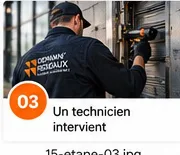
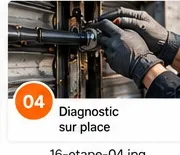
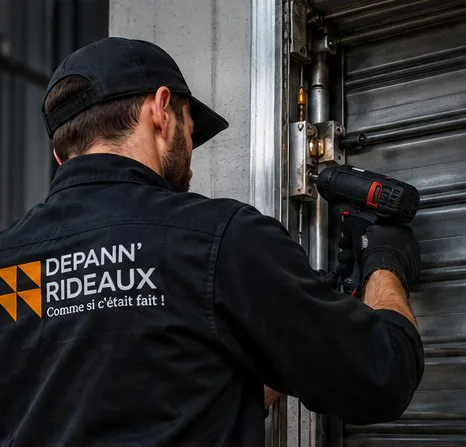
Manufacture is only launched on dimensions taken on site by the technician, never on an old drawing or measurements given over the phone.
- 1Site surveyMeasurement of the opening (width, height, headroom, side room), the floor and the supporting structure.
- 2Usage reviewCycles per day, forklift or lorry traffic, hygiene, temperature or fire safety constraints.
- 3Technical choice and quoteDoor type, panels or curtain, windows, wicket door, automation and safety devices: each item is listed on the quote.
- 4ManufactureOnce approved, the door is built to the measured size. The manufacturing lead time, which depends on the door type and options, is stated on the quote.
- 5Installation and commissioningAssembly, adjustment, safety tests and handover of documents, described on our industrial door installation page.
Which options should you choose for a made-to-measure industrial door?
Options are chosen on three criteria: light, people’s movements and insulation.
Windows and glazed panels
They bring in daylight and let you see a vehicle or person on the other side of the door before it opens.
Plan for: a viewing height that suits forklift drivers.Built-in wicket door
A pedestrian door within the sectional door avoids opening the whole bay for a simple passage and separates traffic.
Plan for: the threshold and its use as an emergency exit, depending on your building.Insulation and sealing
Panels with an insulating core, perimeter seals and a bottom seal limit heat loss and keep out wind and rain.
Plan for: the insulation level, depending on whether the building is heated.Colour and finish
A RAL colour matched to the cladding or company branding, with a finish suited to how exposed the façade is.
Plan for: the colours available in the chosen range.Which material and finish stand up to the Normandy climate?
On the coast and in the ports, choose galvanised and coated steel panels or aluminium, with corrosion-treated hardware. The salt air of Le Havre, Dieppe, Fécamp or Cherbourg quickly attacks bare steel, tracks and fixings.
Wind is the other Normandy constraint: a large door exposed to gusts must be sized to resist wind pressure, a performance declared by the manufacturer under EN 13241. Inland, in the Eure or the Orne, humidity and condensation in unheated buildings tend to guide the choice of seals and ventilation.
Is automation planned from the manufacturing stage?
Yes: it is the ideal moment to choose the operator, because the motor, control panel and safety devices are sized for the actual door. The control options, from push-button to floor loop detection, are presented on our industrial door automation page. You can also keep a manual door and motorise it later if your traffic grows.
How much does a made-to-measure industrial door cost?
The price depends on the size, the door type and the options: it is set out in a written quote after the site survey.
Site survey free, itemised quote with no obligation. Every item, from the door to the automation, is described before anything is ordered.
- The size of the opening: door area and reinforcement needed.
- The door type: sectional, high-speed, roller shutter or fire door.
- Insulation and options: windows, wicket door, finish.
- Automation and safety devices: motor, controls, detection.
- Associated work: removing the old door, reworking the opening or power supply if needed, included in the quote and carried out by us or coordinated with a partner tradesman.
Where do we supply made-to-measure industrial doors?
Throughout Normandy: warehouses in Le Havre and Port-Jérôme, platforms in the Seine valley around Rouen, business parks in Caen and Évreux. For a simple wide shutter, see also our warehouse roller shutters and made to measure roller shutters. The full range is on the industrial doors page.