A motorised metal roller shutter opens with a turn of a key or the press of a button, without lifting the curtain at arm’s length. For a shop that opens and closes every day, that saves time and effort and improves security. But the motor has to suit the shutter and be properly adjusted and maintained: an underpowered motor strains, overheats, trips its safety cut-out and ends up failing at the worst moment, often one evening at closing time.
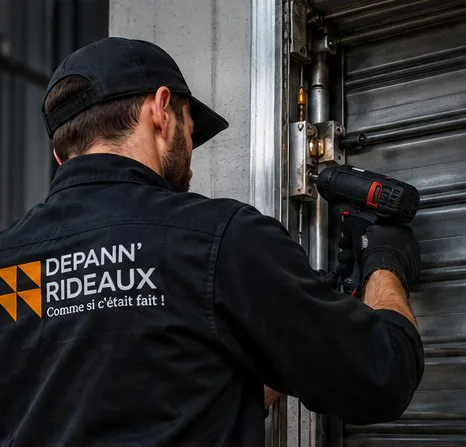
At DEPANN'Rideaux, motorisation is a trade in its own right, not a sideline to emergency repairs. The technician who answers knows central and tube motors, brakes, limit switches, control boxes and radio receivers. He asks about your shutter (width, height, type of slats, how often it is used), points you to the right solution and comes with the right parts. The price itself is given to you on site, after the diagnosis and before any work starts.
What does our roller shutter motor service include?
Our service covers the motor’s whole life: choice, fitting, adjustment, repair, replacement, controls and maintenance. Each need has its own detailed page.
- Motor repairMethodical diagnosis on site: power supply, controls, capacitor, brake, limit switches.
- Motor replacementA new motor sized for your curtain, reusing your existing controls.
- Motorise a manual shutterA motor kit fitted to your existing shutter, once we have checked it is feasible.
- Remotes and control boxesKey switch, push-button control box, radio remote: adding, duplicating, replacing.
Central motor or tube motor: what is the difference?
A central motor is fixed in the middle of the axle, outside the tube, whereas a tube motor sits inside the axle. Both turn the axle to roll up the slats of the curtain, but they do not suit the same shutters or the same fitting constraints.
| Criterion | Central motor | Tube motor |
|---|---|---|
| Position | In the centre of the axle, between two half-axles | Inside the barrel |
| Shutters concerned | Wide, heavy shutters: shop fronts, garages, warehouses | Shutters of more modest size and weight |
| Space required | Visible in the shutter box, needs room in the centre | Hidden, compatible with a compact shutter box |
| Access for maintenance | Direct, without removing the axle | Usually means taking the axle down |
| Manual override | Common (crank or winch), depending on the model | Less common, depending on the model |
| Brake and anti-drop | Electromagnetic brake, often combined with a safety brake (anti-drop device) | Brake built into the motor; anti-drop depending on the installation |
| Replacement | Motor changed on its own, axle usually kept | A longer job, with the axle taken down |
General technical comparison: exact specifications depend on the model.
In practice, the width and weight of the curtain almost always decide it. On a large shop front, a garage or a warehouse, a central motor is the usual solution. On a small unit, a storeroom or a light shutter, a tube motor is often enough and frees up space in the shutter box. To see all the equipment on an electric roller shutter, visit our dedicated page.
How do you choose a motor suited to the weight and width of the curtain?
A motor is chosen first on its torque, in other words its turning force, which must be enough to roll up the full curtain with a safety margin. That torque depends on several factors the technician records before proposing a model:
- The area of the curtain: the wider and taller the shutter, the heavier it is to roll up.
- The type of slats: for the same area, a solid slat curtain is generally heavier than a tube and link grille.
- The material: galvanised steel, aluminium and stainless steel do not weigh the same.
- The axle diameter: it determines the torque needed and whether the motor is compatible.
- How often it is used: a shop that opens in the morning and closes in the evening does not have the same needs as a warehouse whose shutter goes up and down all day.
- The power supply available: single-phase or three-phase, depending on the motor and the premises’ installation.
We never choose a motor “by eye”. An underpowered motor strains every time, trips its thermal cut-out and wears out early. An oversized motor costs more and adds nothing. The right motor is the one that matches your curtain, not necessarily the one that was there before: a shutter whose slats have been changed or reinforced sometimes no longer weighs the same.
Which controls can be fitted to a motorised shutter?
A motorised shutter can be operated by a key switch, a push-button control box, a radio remote or a keypad. These controls are often combined: a key outside, buttons inside, a remote for deliveries.
Key switch
A switch fitted outside, next to the shutter: only the keyholder can open or close it.
Ideal for: shops with no other way in than the shutter.Switch or push-button control box
An indoor control with up, down and stop, sometimes with an emergency stop button as well.
Ideal for: premises with a service entrance.Radio remote control
A receiver connected to the motor takes the command from the remote: you can open without getting out of the vehicle.
Ideal for: garages, workshops, delivery areas.Keypad
A wall-mounted keypad operates the shutter with a code: no keys to hand out, and the code can be changed when needed.
Ideal for: teams who take turns opening and closing.Adding remotes, replacing one that has been lost, flush-mounted or surface-mounted controls: it is all covered on our remotes and control boxes page.
Which safety devices protect a motorised roller shutter?
A motorised shutter is protected by several complementary devices: brake, anti-drop system, limit switches, thermal cut-out and, on some models, a manual override. We check them at every installation and every visit.
- Electromagnetic brake: it locks the axle as soon as the motor stops. It holds the curtain in position and prevents it from being lifted by hand.
- Safety brake or anti-drop device: if the axle or the drive gives way, this device stops the curtain from falling. It is particularly important on heavy shutters.
- Limit switches: they stop the motor at the top and bottom positions. If they are out of adjustment, the shutter strains against its stops or stops too early.
- Thermal cut-out: it switches the motor off if it overheats after repeated operation, then lets it restart once it has cooled down.
- Manual override: a crank or winch lets you open or close during a power cut, on motors that have one.
- Control mode: with a hold-to-run control, the shutter only moves while you keep pressing, in sight of it. An impulse control, where a single press is enough, requires additional safety devices, such as obstacle detection.
Manual override: only if your shutter has one and the manual says so. Never take apart the shutter box and never touch the axle, the motor or the electrical wiring: a curtain that is not properly held can drop suddenly. If in doubt, call +33 7 68 20 39 55.
What should you do when your shutter motor stops responding?
First check the circuit breaker, the remote’s batteries and the emergency stop button, then call a technician without repeatedly pressing the control. Operating the shutter over and over makes the motor overheat and can make the fault worse.
The most common causes are well known: a worn capacitor, a jammed electromagnetic brake, misadjusted limit switches, a tripped thermal cut-out, or a faulty radio receiver or control board. To recognise the symptoms, see our page on a roller shutter motor not working. To find out how our technicians isolate the faulty part, read our roller shutter motor repair page. Emergencies are handled 24/7 by our emergency roller shutter repair service.
When should the motor be replaced rather than repaired?
The motor should be replaced when a repair is no longer reliable: burnt-out windings, a worn gearbox, parts that can no longer be found or repeated breakdowns. As long as a capacitor, a limit switch adjustment or a brake part will do the job, we repair.
Replacement is also the opportunity to correct a motor that was the wrong size from the start, or to switch from a tube motor to a central motor when the curtain has become too heavy. The key switch, push-button control box and receiver are reused if they are compatible, and we take away and recycle the old motor. The whole process is explained on our roller shutter motor replacement page.
Can a manual metal roller shutter be motorised?
Yes, a manual shutter can generally be motorised, provided the curtain, the axle and the guide rails are in good condition. The technician first checks it is feasible: straight slats, a sound axle, spring boxes in working order, space available in the shutter box.
The usual solution is a central motor kit mounted on the existing axle, with its brake, its limit switches and the control of your choice. A dedicated power supply is needed near the shutter box: if there isn’t one, an electrician installs it beforehand. You no longer lift the curtain, you no longer bend down to a lock at ground level, and closing up in the evening takes a few seconds. Details and conditions are on our motorise a manual roller shutter page.
Is maintenance of a motorised roller shutter compulsory?
Yes, in a workplace: the regulations require automatic and semi-automatic doors and closures to be maintained and inspected at least every six months. These obligations are set out in the French Labour Code (Code du travail, articles R4224-12 and R4224-13) and in the arrêté du 21 décembre 1993. The work must be recorded in an up-to-date maintenance log. In a building open to the public (ERP), further inspections apply under the fire safety regulations. The reference product standard is NF EN 13241, which covers industrial and commercial doors and closures.
During a visit, we check the motor fixing, the brake, the anti-drop device, the limit switches, the controls, the guide rails and the condition of the slats, then fill in the log. Find all the details in our guide on mandatory roller shutter maintenance and our maintenance contract.
How does a motorisation project work?
A motorisation or motor replacement project follows five steps, with the same contact from the first call to the final tests.
- 1A chat with the technicianDimensions, type of slats, how the premises are used, a photo of the shutter and, if it can be read without opening the shutter box, of the current motor’s rating plate.
- 2Site survey and measurementsA free site survey: condition of the curtain, the axle and the brackets, space in the shutter box, power supply available.
- 3Written quoteMotor, controls, safety devices and labour: the price is fixed before the work and does not change on site without your agreement.
- 4Fitting and adjustmentFixing the motor, connecting the controls, setting the limit switches, testing the brake and the anti-drop device.
- 5Back in serviceFull testing, a walk-through of the controls and the manual override, an updated maintenance log and a detailed invoice.
How much does it cost to motorise a roller shutter?
The price of motorisation or work on a motor depends on the type of motor, the weight of the curtain, the controls chosen and the condition of the installation: it is always given to you before any work. For an emergency repair, the technician gives it to you on site, after the diagnosis and before starting, and nothing is done without your agreement: if you decline the work after the diagnosis, only the call-out is charged. For fitting or replacing a motor, it appears on a written quote, provided after the on-site survey and before the work.
- The type of job: replacing a capacitor or adjusting limit switches is nothing like supplying and fitting a new motor.
- The type and power of the motor: a central or tube motor, chosen according to the torque needed; replacing a tube motor also means taking the axle down.
- The controls: key switch, push-button control box, keypad, number of remotes to program.
- The safety devices: brake, safety brake, and additional devices if you choose an impulse control.
- The condition of the installation: whether the axle, brackets and shutter box need work, and whether there is a power supply or one has to be installed by an electrician.
- Time of day and distance, for an emergency repair: a surcharge applies at night (8 pm to 8 am), on Sundays and on bank holidays; it is included in the price the technician gives you on site, before any work starts; the call-out charge depends on the distance from our base in Gruchet-le-Valasse and is given to you together with the price of the job.
Guarantee on a new motor fitted by us: 2 years on the motor (manufacturer's warranty) and 1 year on fitting. Payment by bank card, bank transfer or cheque.
Price given on site, before any work. On the phone, describe your shutter to the technician, with a photo if possible: he advises you, tells you when he can get there and brings the right parts; the price itself is set after the diagnosis. To find out more: how the price of a repair is set.
Where do we fit and repair roller shutter motors?
Our technicians fit, repair and replace shutter motors across the departments of Normandy, for town-centre shops as well as garages, workshops and warehouses on business parks:
Why trust DEPANN'Rideaux with your motor?
- You speak to the technicianNo national switchboard: the person who answers knows motors and handles your job.
- A motor chosen for your curtainSized to measure, not one model fitted everywhere.
- All makes, common parts in stockIn the van: capacitors, limit switches, universal remotes and receivers, cylinders, galvanised slats and common spring boxes, as well as central motors in common power ratings.
- Price given on site, detailed invoiceAfter the diagnosis, you know what you are paying before the work, and why.