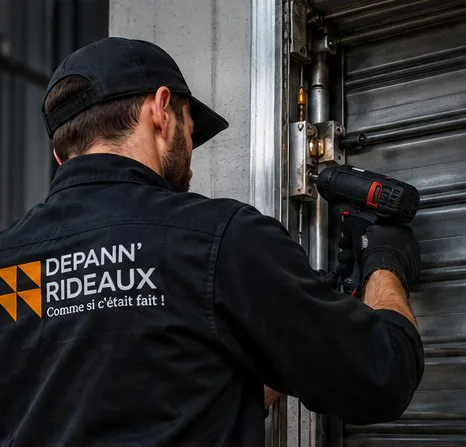
In short: choose an industrial door first by use (passages per day, insulation, security, fire protection), then by the space available around the opening. In a workplace, a powered door must be maintained and inspected at least every six months, with a maintenance log. When it breaks down, the whole operation stops: hence the value of a contact you can reach directly, who tells you on the phone whether he can come out.
What counts as an industrial door?
An industrial door is a large closure designed for intensive professional use: a warehouse entrance, a workshop access, a loading bay, a partition between two areas of a building. It has to cope with repeated cycles, wind on an open frontage, knocks from forklifts and, depending on the case, temperature differences or fire risk.
The term covers several very different families: an insulated sectional door has neither the same mechanism, nor the same faults, nor the same maintenance as a high-speed PVC fabric door or a fire door. In Europe, these doors fall under the product standard EN 13241 (NF EN 13241 in France), which covers their performance and safety in use; EN 12453 sets the safety requirements for powered doors (obstacle detection, force limitation, emergency stop).
At DEPANN'Rideaux, we are roller shutter repairers first and foremost. We apply the same method to the doors of your commercial buildings: a technician answers the phone, understands your site and tells you plainly what he can do. We handle sectional doors, high-speed doors, loading bay equipment, fire doors and industrial roller shutters, all makes, from the major brands on the market to older models.
What types of industrial doors are there?
There are five main families of industrial closures, each meeting a specific need. The cards below help you find your way before opening each model’s detailed page.
Industrial sectional door
Hinged horizontal panels that run up along tracks and sit under the ceiling or against the wall. Insulated panels limit heat loss.
For: heated warehouses, workshops, dealerships, farm buildings. See the industrial sectional door.High-speed door
A technical fabric curtain that rolls up or folds in moments. It stays open for as short a time as possible between passages.
For: forklift traffic, cold areas, food industry, separating halls. See the high-speed door.Loading bay equipment
Dock leveller, bumpers, dock shelter, lift table: everything needed to load a lorry at floor level, in the dry and safely.
For: logistics hubs, parcel carriers, industry. See loading bay equipment.Fire door
A door classified to resist fire for a given time and to close by itself when the alarm sounds, so as to compartmentalise the building.
For: high-risk rooms, storage, public buildings, separating storage cells. See the fire door.Industrial roller shutter
The metal shutter in a wide, motorised version with steel slats: sturdy, compact and a strong deterrent against break-ins.
For: unheated warehouses, depots, HGV garages. See the warehouse roller shutter.Many sites combine several closures: a sectional door on the frontage for insulation and night-time security, a high-speed door behind it for daytime traffic, equipped bays for lorries and fire doors between storage cells.
How do you choose the right industrial door for your building?
The right choice starts from how the opening is really used, not from a catalogue. Before any survey, ask yourself: how many times a day does the door open? Is the building heated or refrigerated? What is inside at night? Is there a fire requirement? How much space is left above the lintel and at the sides?
| Your priority | Closure to look at first | Watch point |
|---|---|---|
| Keeping heat in a heated building | Sectional door with insulated panels | Perimeter seals and threshold in good condition |
| Very frequent forklift traffic | High-speed door, alone or as a second door | Presence detection and impact protection |
| Resisting break-ins at night | Roller shutter or solid sectional door | Locking and key or keypad control |
| Loading and unloading lorries | Equipped bay: leveller, bumpers, shelter | Bed heights of your hauliers’ vehicles |
| Fire compartmentation | Classified fire door | Classification required by the inspection body or insurer |
| Little space above the opening | Sectional door with suitable lift type, or compact shutter | Headroom and routing of ducts |
This grid is a first pointer: the final choice is made on site, after measuring the opening and talking to the people who use the door every day.
Two criteria are often underestimated. First, operation during a power cut: a powered door must be openable by hand, with a chain, crank or release, depending on the model. Second, people’s safety: photocells, a safety edge at the bottom of the curtain, an anti-fall device in case a spring or cable breaks. These are not comfort options.
What services do we offer for industrial doors?
We look after an industrial door throughout its life: design, fitting, automation, periodic maintenance and repair. Each service has its own detailed page.
- Industrial sectional doorsInsulated panels that rise up under the ceiling: the door for heated buildings, workshops and warehouses.
- High-speed doorsA fabric door that opens and closes in an instant: for forklift traffic, cold areas and the food industry.
- Loading bay equipmentDock leveller, bumpers, dock shelter, lift table: loading a lorry level, in the dry and safely.
- Fire doorsHinged, sliding or rolling: the door that compartmentalises your building and closes by itself in a fire.
- Emergency repair (industrial doors)Sectional door stuck, high-speed door knocked out, loading bay down: fault described over the phone, price given on site, call-out 24/7.
- Made to measure (industrial doors)A sectional door, high-speed door or industrial shutter built to the size of your opening, with automation suited to your traffic.
- Automation (industrial doors)Motor, control panel, photocells, safety edge and controls: safe automation suited to your traffic.
- Installation (industrial doors)Removal of the old door, fitting, wiring, adjustment and tests: an industrial door handed over ready to use.
- Maintenance (industrial doors)Inspections at least every six months, safety tests and a maintenance logbook kept up to date for all your doors.
For a new project, the site survey is free, and so is the quote: the technician measures the opening, looks at the structure that will take the tracks or guide rails, notes the available power supply and gives you a written proposal.
What are the maintenance obligations for an industrial door?
In a workplace, automatic and semi-automatic doors and gates must be maintained and inspected at least every six months. This obligation comes from the French Labour Code (articles R4224-12 and R4224-13) and the arrêté of 21 December 1993, which sets out what the inspections cover. Each visit must be recorded in a maintenance log kept up to date by the site manager.
- For the operator: an up-to-date log helps in the event of a labour inspection, an insurer’s visit or an accident.
- For the door: wear spotted early is fixed with an adjustment or a small part, before it breaks in the middle of a delivery day.
- For fire doors: correct operation is also checked under fire safety rules, depending on the type of building.
The rules applied to shutters are explained in our guide to mandatory roller shutter maintenance in France; for a site door, see our industrial door maintenance offer. For a site with several doors, we offer a single maintenance contract: the doors covered and how often we visit are set out in the contract.
What should you do if your industrial door breaks down?
First make the area safe, then call a technician without trying to force the door. A door stuck in the up position leaves the building open; stuck down, it immobilises the lorries and the teams. Either way, the temptation is to “give the door a hand”: that causes many accidents.
Which risk-free steps should you take before calling?
- Clear the way. Nobody under the door, no forklift or goods in the area below it.
- Check the power. The door’s circuit breaker, an emergency stop pressed by mistake, the key switch.
- Look without touching. Slack cable, panel out of its track, torn fabric, unusual noise: note it and take a photo.
- Call +33 7 68 20 39 55. The technician gives you safety instructions and tells you whether he can come out and how soon. The price is given on site, after the diagnosis and before any work starts.
Every situation is described on the industrial door repair page. For a metal shutter on a building, our 24/7 emergency roller shutter repair service applies directly.
Why does the Normandy climate wear industrial doors faster?
Because damp, salt and wind constantly attack metal parts and seals. A door fitted in the Le Havre port and industrial zone or on a site on the Channel coast does not age like a workshop door sheltered inland.
- Salt air: on the coast, it eats into galvanised steel, tracks, springs and fixings faster. More frequent checks and cleaning of the tracks are recommended.
- Damp: the mists of the Seine valley and the Pays de Caux encourage corrosion of cables and oxidation of electrical contacts.
- Wind: on exposed frontages on the plateaux, a large door catches a lot of wind. It must be sized for its location and properly locked.
That is also why we recommend a technician’s visit before winter: a split seal or a rusty track is easier to spot in dry weather than in the middle of a storm.
How does an industrial door project work?
An industrial door project follows five steps, from the first call to commissioning, with the same contact from start to finish.
- 1First conversationYou describe the building, how the opening is used and your constraints. The technician points you towards one or two types of door.
- 2Site survey (free)Measuring the opening, headroom and side room, condition of the masonry or frame, power supply.
- 3Detailed quoteType of door, insulation, motor, safety devices, options: everything is in writing. You compare with full knowledge.
- 4Fitting and connectionFitting organised to limit downtime for your business, then adjustments and safety tests.
- 5Commissioning and follow-upHandover to your teams, opening of the maintenance log and scheduling of periodic visits.
How much does an industrial door cost?
There is no single price: the cost of an industrial door depends on its size, the type of closure, insulation, motor, safety devices and the work around the opening. An insulated motorised sectional door, a high-speed door and a fire door are not comparable. For a project, we draw up a detailed quote after the site survey, which is free.
For a repair, the technician gives you the price on site, once the fault is diagnosed: nothing is done without your agreement. Good to know: a surcharge applies at night (8 pm to 8 am), on Sundays and on bank holidays; it is included in the price the technician gives you on site, before any work starts; the call-out charge depends on the distance from our base in Gruchet-le-Valasse and is given to you together with the price of the job. Finally, if you decline the work after the diagnosis, only the call-out is charged.
Where do we work on industrial doors in Normandy?
We cover all five Normandy departments, from the logistics zones of the Seine estuary to the business parks of the Caen plain and the Eure. Our base in Gruchet-le-Valasse is close to the Port-Jérôme industrial zone and the Le Havre – Rouen corridor.
The full list of towns we cover is on the areas we cover page.